
Hidalgo County Parole Versus Probation
Parole and probation both allow a person to live outside an institution while following supervision terms, but they begin in different ways. Probation usually comes from the sentencing court. It may take the place of some jail time or follow a short custodial term. Parole follows a New Mexico state-prison sentence and involves the New Mexico Parole Board and the New Mexico Corrections Department, or NMCD. Neither status means the case has vanished. Both can involve reporting, an approved residence, treatment, travel limits, and other terms found in the individual order.
A county-jail release record proves when Hidalgo County Detention Center custody ended. It does not, by itself, prove whether probation began. The official page for Sheriff William Chadborn identifies the county law-enforcement channel, while New Mexico Case Lookup helps locate the court order. Likewise, a prison gate date is not the same as the end of parole. Under New Mexico law, a parolee remains in legal custody while on parole. Final discharge comes later, after the Board determines that the obligations were performed and issues an order and certificate.
| Point | Probation | Parole |
|---|---|---|
| Starting authority | Sentencing court | Parole Board after prison |
| Typical custody path | May replace or follow confinement | Follows release from state prison |
| Local verification | NMCD search, court docket, Lordsburg office | NMCD search, Lordsburg office, Board record |
| Strong end record | Court or NMCD completion record | Final discharge order and certificate |
- Supervision
- Rules and reporting duties that apply while a person lives in the community.
- Discharge
- The formal end of a custody or supervision obligation, shown by the responsible agency’s record.
- Revocation
- A legal process that can cancel community release after a proven violation.
Check Hidalgo County Supervision Status
The NMCD Offender Search covers state prisoners and people on probation or parole. It does not cover routine Hidalgo County jail custody. The live form accepts last name, first name, or offender number. It also offers Active, Include Inactive, and Absconder Only filters. Active is the useful starting point for current supervision. Include Inactive is important when completion may have occurred. Match more than a name when the result supplies age, number, region, or other identifiers.
NMCD says prison data updates nightly and probation/parole data updates in real time, but movement can still make the display incomplete. The agency directs users to verify legal status and location with the institution or supervision office. A search result is therefore a lead, not a substitute for the current case record.
- Open the NMCD search and enter the offender number when known. Otherwise, use the full name and age range.
- Use Active to look for current parole or probation. Read the result carefully because Active can also mean prison custody.
- Repeat with Include Inactive when supervision may have ended. Do not treat a missing or inactive result as automatic discharge.
- Check the court docket for probation, revocation, warrant, amended sentence, or satisfaction entries tied to the Hidalgo County case.
- Call the displayed supervising office and ask whether the public status and assigned office remain current.
- When final parole discharge matters, seek the Board’s discharge order or certificate under NMSA 1978 §31-21-10(F).
Important: Physical release, active community supervision, and final legal discharge are separate events. Report only the event the record proves.
For the full custody-side path before supervision began, the Hidalgo County released-inmate search explains how the detention record and court order work together.
Hidalgo County Supervision Office
Hidalgo County has a local verification route. The NMCD Region III page places the county in the southern region and lists the Lordsburg Sub Office, District 6. This office is a community-supervision location, not a jail. It can help distinguish a person who left prison but remains on parole from someone whose state supervision ended. Staff may limit the details they disclose, yet the office is the right place to verify whether a public assignment is current.
NMCD Lordsburg Sub Office
524 DeMoss Street, Suite 10
Lordsburg, NM 88045
Direct: 575-520-6038
Main: 505-660-4905
Supervisor listed: Marissa Miranda
The official Region III source is especially useful because older court-resource pages may carry a different number. Use the current NMCD listing. The statewide probation/parole assistance and emergency response line shown in the research is 866-416-9867.
The official Lordsburg office view shows the local channel that follows a statewide search. Review the NMCD Region III listing before using the contact details.
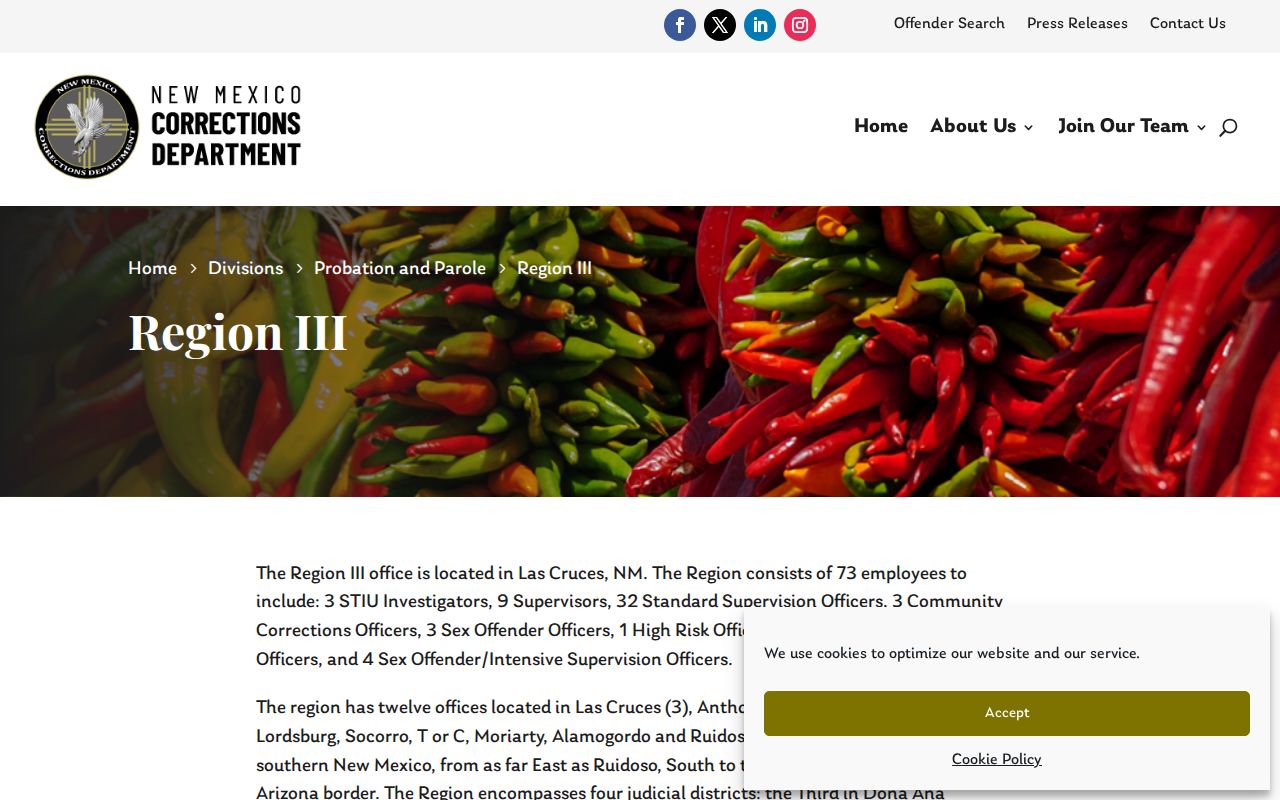
The image connects Hidalgo County supervision to a named Lordsburg suboffice rather than a general Santa Fe contact.
Note: An assigned office can change, so verify the office and legal status before relying on an older printout or saved search result.
Hidalgo County Absconder Records
The Absconder Only filter has a narrow meaning. NMCD describes an absconder as a supervised person whose whereabouts are no longer known to the officer after reasonable efforts. The search may be run without a name or offender number, but it is not a release list. An absconder has not successfully completed supervision and should not be described as discharged, free of supervision, or lawfully released from all obligations.
The NMCD absconder policy describes steps that may include checking the last reported address, preparing a violation report, and seeking a bench warrant when appropriate. A bench warrant is a court order authorizing arrest. Its existence and scope must come from the actual court or agency record. Do not infer a warrant from rumor or from a stale directory entry.
When an Absconder Only result appears, compare the identifiers, check the relevant New Mexico court docket, and contact the supervising office. A later inactive result also needs context. It might reflect a resolved case, a data change, or technical trouble. NMCD specifically warns that disappearance from the display does not prove release or completion.
Hidalgo County Parole Board Records
The New Mexico Parole Board grants, denies, or revokes parole and conducts parole and revocation hearings. It is administratively attached to NMCD but acts independently. The public archive contains quarterly Board meeting notices. Those meetings concern public Board business and are not a person-level hearing calendar. No public person-level hearing or decision search was found in the research.
For a specific hearing date or releasable decision, contact the Board or request the existing record. The listed address is 4337 State Road 14, Santa Fe, NM 87508; telephone 505-827-8853; email nmapb.paroleboard@apb.nm.gov. Typical terms such as grant, deny, defer, rescind, or revoke should be used only when they appear in the individual record. A public meeting agenda cannot establish the outcome of one person’s case.
Parole eligibility also depends on the sentence and governing law. Ordinary determinate sentences, life terms, some youth sentences, and specialized sex-offender provisions do not follow one universal timetable. The Board’s rules and the controlling judgment must be read together. Release may also wait for an adequate parole plan and acceptance of conditions.
Hidalgo County Supervision Discharge
New Mexico law draws a firm line between release from prison and final discharge. Under NMSA 1978 §31-21-10(D), ordinary parole periods after many first-, second-, or third-degree felonies are generally two years, while a fourth-degree felony is generally one year. Important exceptions apply. Section 31-21-10(E) addresses parole conditions, an approved plan, and continued legal custody. Those provisions should never be reduced to a one-size-fits-all end date.
The strongest parole endpoint is the final discharge process in §31-21-10(F). After the person performs the obligations of release, the Board orders final discharge and issues a certificate. A prison release date proves departure from the institution. A final discharge certificate proves the later end of parole obligations. For probation, use the sentencing court docket and NMCD supervision record to locate the applicable completion or discharge entry.
Community-parole credits can affect the later end of legal custody in defined cases. They generally depend on the supervising officer’s recommendation and final Board approval, and previously awarded credit may be removed. That process should not be used to revise the historical prison exit date. It belongs to the supervision calculation and the Board record.
VINE can send custody-change notices when the relevant system participates, but it is not a supervision archive. New Mexico’s NMCD VINE service was undergoing an upgrade on the research date, and VINE registration does not replace verification with the Lordsburg office or Board. Separate written notice for qualifying victims is handled through the prosecuting district attorney.
Note: A court docket can explain the legal order, while the supervision agency confirms how that order is being administered now.
Hidalgo County Reentry Health Work
A federal HRSA award to Lordsburg-based Hidalgo Medical Services describes transition-in-care work for justice-involved people during the final period before release and after return to the community. This is distinctive local context because health continuity can overlap the first months of probation or parole. The award does not state that Hidalgo County Detention Center participates, and it does not prove that any named person qualifies.
The careful conclusion is limited: a Lordsburg grantee received an award describing release-transition health work. Current services, enrollment rules, and eligibility must come from the provider. It should not be treated as proof of a supervision term, a release date, or access for every person leaving county or state custody.